

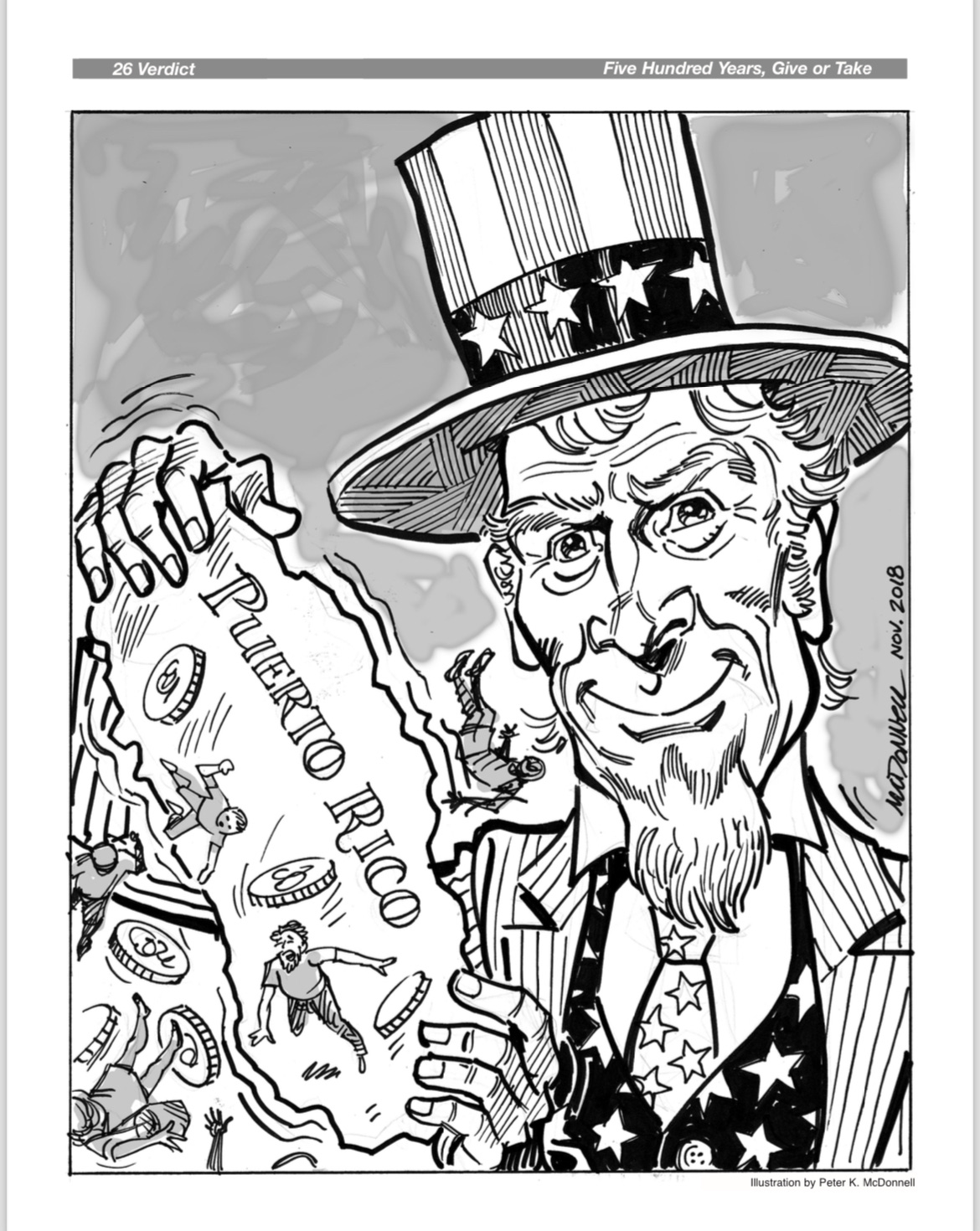
This is an article I wrote that has been printed with the National Coalition of Concerned Legal Professionals. They have given me permission to post. Please note the artist credits because all writers and artists volunteer their time and please write to NCCLP is you wish to receive a paper copy of this edition of Verdict or future editions.
As the above can be hard to read on the screen, this is the text of the article:
500 years, give or take
Elisa M. Tustian, Esq.
Columbus sailed the ocean blue
in fourteen hundred ninety-two
Puerto Rico he did see
in fourteen hundred ninety-three
First to Spain
When the Spanish landed in Puerto Rico during the 1400s, the natives believed that the Spanish were Demigods (nod to Disney’s Moana). Demigods who sought Gold! The natives themselves used the gold to mark status via disks worn by chiefs and their relatives. The natives led the Demigods to the gold and helped them retrieve it, but when the Demigods were behaving too much like irrational, desperate humans the natives began to wonder if they were mortal. Like any rational being, they decided to try to drown one of the Spaniards. If he drowned, he was human. If he revived himself, he was Demigod.
You can guess the result absent details, and the natives quickly shared the news.
After the news got around, the natives who had been divided up as slaves amongst Spaniard lords started to meet at night and plan their rebellion. Amongst them there was a spy by the name of Juan Gonzalez, who attended a night meeting in disguise and warned the young Spanish aristocrat Christopher de Soto Mayor of the coming Rebellion. Soto Mayor tried to flee but to no avail. The rebellion of 1511 started with an attack on his Spanish settlement by three thousand natives led by Guárionex, and they won, leaving the settlement in ashes, and apparently getting Soto Mayor in the woods as he tried to flee!
Gonzalez who also tried to flee, suffered wounds from a band led by Guaybána, and was left for dead…
Next, in comes Ponce de Leon immediately after report of the native rebellion from the wounded Gonzalez. De Leon strikes a group of five to six thousand natives, camped with Guaybána,after the day’s great effort. De Leon and the Spaniards used their armor and their guns to execute a quick return to power, and that first victory of the native rebellion lasted only a few hours.
Thus, the Spanish settled in Puerto Rico in the early 1500s, and the Spanish would later settle in Florida in the mid-1500s and New Mexico in the late 1500s, to name a few.
Examples of other European settlements within the current USA and its territories are the French in Maine in the early 1600s, the British in Virginia in the early 1600s, the Dutch in New York in the 1600s, the famous British Pilgrims in Massachusetts in the 1600s, the French in Detroit, New Orleans, and St. Louis in the 1700s and the Spanish in California in the mid-1700s.
Prior to settling in what is now the mainland USA, European nations tried to fight the Spanish for Puerto Rico. Battles between the British and the Spanish in Puerto Rico took place in 1595 and 1598, between the Dutch and Spanish in 1625 and then between the British and Spanish in 1768 and 1797. After the United States was formed in 1776, we too fought the Spanish for Puerto Rico in 1898. We lost once in May of 1898 but returned later that same year in December of 1898 to claim success.
Then to the USA
Following the end of the Spanish-American War, Puerto Rico became a territory of the United States in 1898. In 1900, William Jennings Bryan, politician and opponent of imperialism said, “If the Porto Ricans, who welcomed annexation, are to be denied the guarantees of our constitution, what is to be the lot of the Filipinos, who resisted our authority? If secret influences could compel a disregard of our plain duty toward friendly people, living near our shores, what treatment will those same influences provide for unfriendly people 7,000 miles away [in the Philippines]?”
President McKinley was serving in office during this time. In 1901, upon McKinley’s assassination there was public outcry in Puerto Rico and streets were named in his honor.
We in the USA were not strangers to territories. Like the Louisiana Territory and the Mississippi Territory, territories were a path to statehood in the USA. A territory is what we called the land that we were working on incorporating.
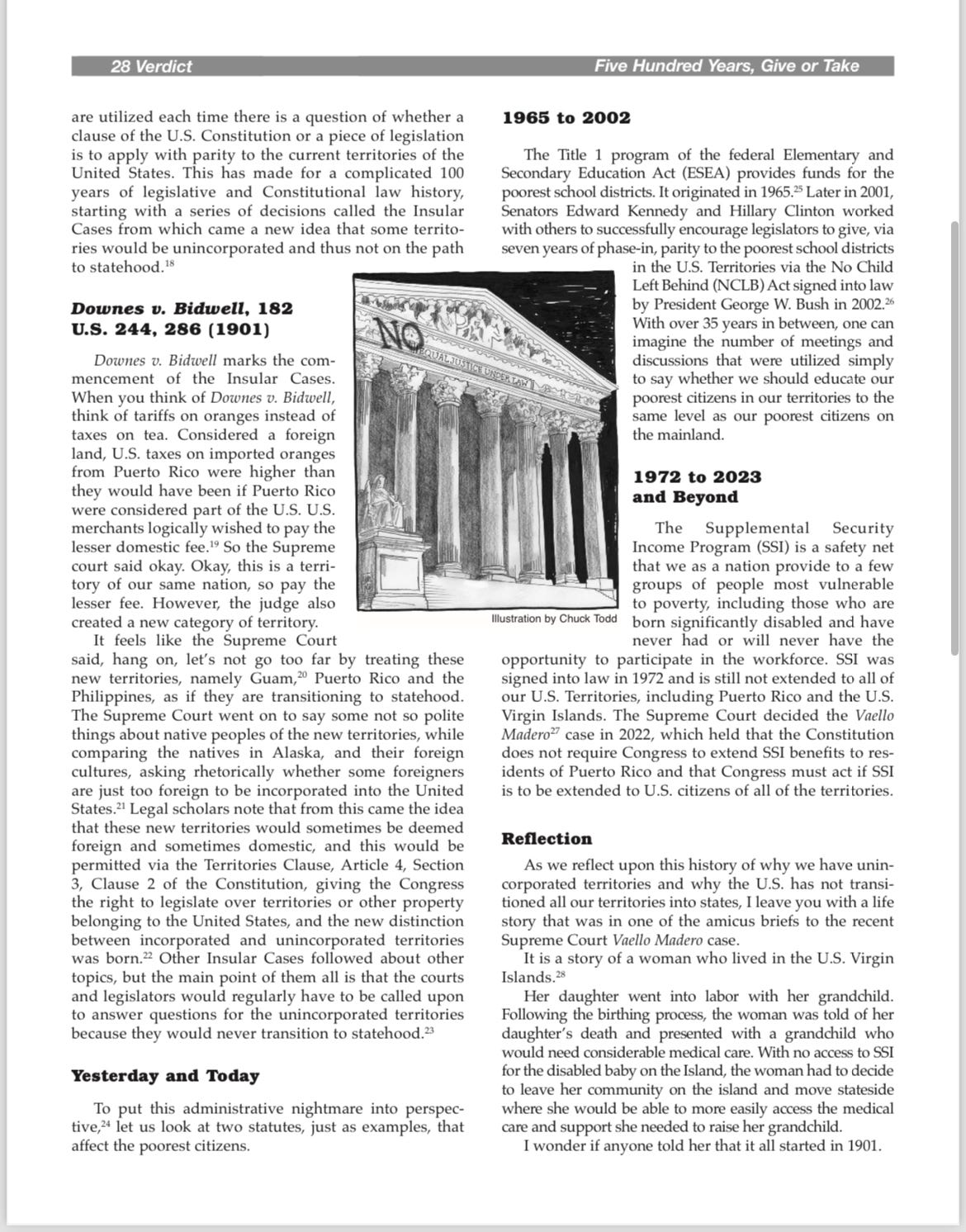
Current scholarship is now looking to the Supreme Court of the early 1900s to explain why Puerto Rico never assumed the path to statehood and remains a territory. As a territory, the US Constitution is not fully applicable to those born Puerto Rico, despite U.S. citizenship, and the time, and resources of the Supreme Court and legislature are utilized each time there is a question of whether a clause of the Constitution or a piece of legislation is to apply with parity to the current territories of the United States. This has made for a complicated 100 years of legislative and Constitutional law history starting with a series of decisions called the Insular Cases from which law scholars cite came a new idea that some territories would be unincorporated, and thus not on the path to statehood.
Downes v. Bidwell, 182 U.S. 244, 286 (1901)
Downes v. Bidwell marks the commencement of the insular cases. When you think of Downes v. Bidwell, think of tariffs on oranges instead of taxes on tea. Considered a foreign land, U.S. taxes on imported oranges from Puerto Rico were higher than they would be if Puerto Rico was considered part of the U.S. U.S. merchants logically wished to pay the lesser domestic fee. So the Supreme court said ok. Ok, this is a territory of our same nation so pay the lesser fee, but the judge also created a new category of territory! It feels like the Supreme Court said, hang on, let’s not go too far by treating these new territories, namely Guam, Puerto Rico and the Philippines, as if they are transitioning to statehood. Perhaps this was in response to society’s chat as discussed by William Jennings Bryan’s thorough speech. The Supreme Court went on to say some not so polite things about native peoples of the new territories, while comparing the natives in Alaska, and their foreign cultures, whether some foreigners are just too foreign to be incorporated into the United States. Legal scholars note that, from this came the idea that these new territories would sometimes be deemed foreign and sometimes domestic, and this would be permitted via the territories clause of the Constitution, and the new distinction between incorporated and unincorporated territories was born. Other insular cases followed about other topics, but the main point of them all is that the courts and legislators would regularly have to be called upon to answer questions for the unincorporated territories because they would never transition to statehood.
Yesterday and today
To put this administrative nightmare into perspective, let us look at two statutes that affect the poorest citizens, just as examples.
1965 to 2002
The Title 1 program of the federal Elementary and Secondary Education Act (ESEA) provides funds for the poorest school districts. It originated in 1965. Later in 2001, Senators Kennedy and Clinton worked with others to successfully encourage legislators to give, via seven years of phase in, parity to the poorest school districts in the US Territories via the No Child Left Behind (NCLB) Act signed into law by President George W. Bush in 2002. With over 35 years in between, one can imagine the number of meetings and discussions that were utilized simply to say should we educate our poorest citizens in our territories to the same level as our poorest citizens on the mainland.
1972 to 2023 and beyond
Supplemental Security Income Program (SSI) is a safety net that we as a nation provide to a few groups of people most vulnerable to poverty, including those who are born significantly disabled and have never had or will never have the opportunity to participate in the workforce. SSI was signed into law in 1972 and is still not extended to all of our US Territories, including Puerto Rico and the U.S. Virgin Islands. The Supreme Court decided the Vaello Madero case last year and said it is the legislator that must act if SSI is to be extended to the US citizens of all of the territories.
Reflection
As we reflect upon this history of why we have unincorporated territories and why not all our territories transitioned into states, I leave you with a life story that was in one of the amicus briefs to the recent Supreme Court Vaello Madero case in 2023.
It is a story of a woman who lived in the US Virgin Islands.
Her daughter went into labor with her grandchild. Following the birthing process, the woman was told of her daughter’s death and presented with a grandchild who would need considerable medical care. With no access to SSI for the disabled baby on the Island, the woman had to make the decision to leave her community on the island and move stateside where she would be able to more easily access the medical care and support she needed to raise her grandchild.
I wonder if anyone told her, it all started in 1901.
Great article illustrating how the past wrongs still truly impact the present and future needs of many.